Chasing Miaplacidus
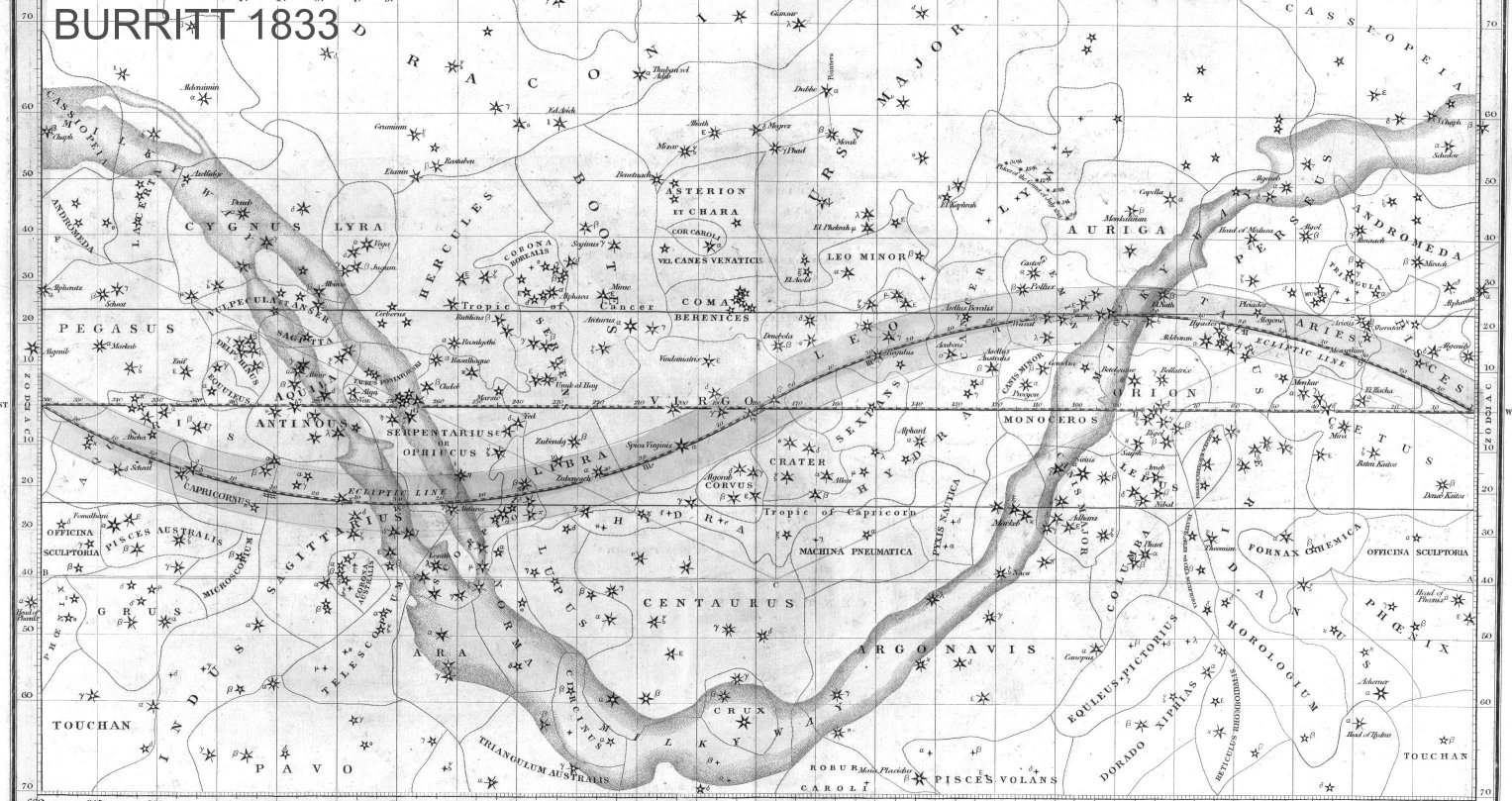
Where did this name for β Carinae (or β Argus) originate? An earlier spelling was "Maia Placidus" but that's not significant. Most sources, including Wikipedia and others, follow Allen's "Star Names" (c.1899) which attributes it to Elijah Burritt's popular 19th century "Geography of the Heavens". Allen also mentioned an entirely speculative etymology published by one W.H. Higgins in 1882 (the "placidus" part is clearly Latin; Higgins suggested "maia" might be from Arabic for "water" but that was just guesswork --the sort of thing all too common in Allen's "Star Names"). The name "Maia Placidus" appears in Burritt's "Geography of the Heavens" in a peculiar large chart in his atlas, which was also available as a large linen wall chart. It's his so-called "planisphere" which is a Mercator chart of a large portion of the celestial sphere. It's an oddity in Burritt since it's drawn in a different style from the main atlas and includes different choices for some modern constellations. And at the very bottom, there's "Maia Placidus" which is also mentioned briefly in the text.
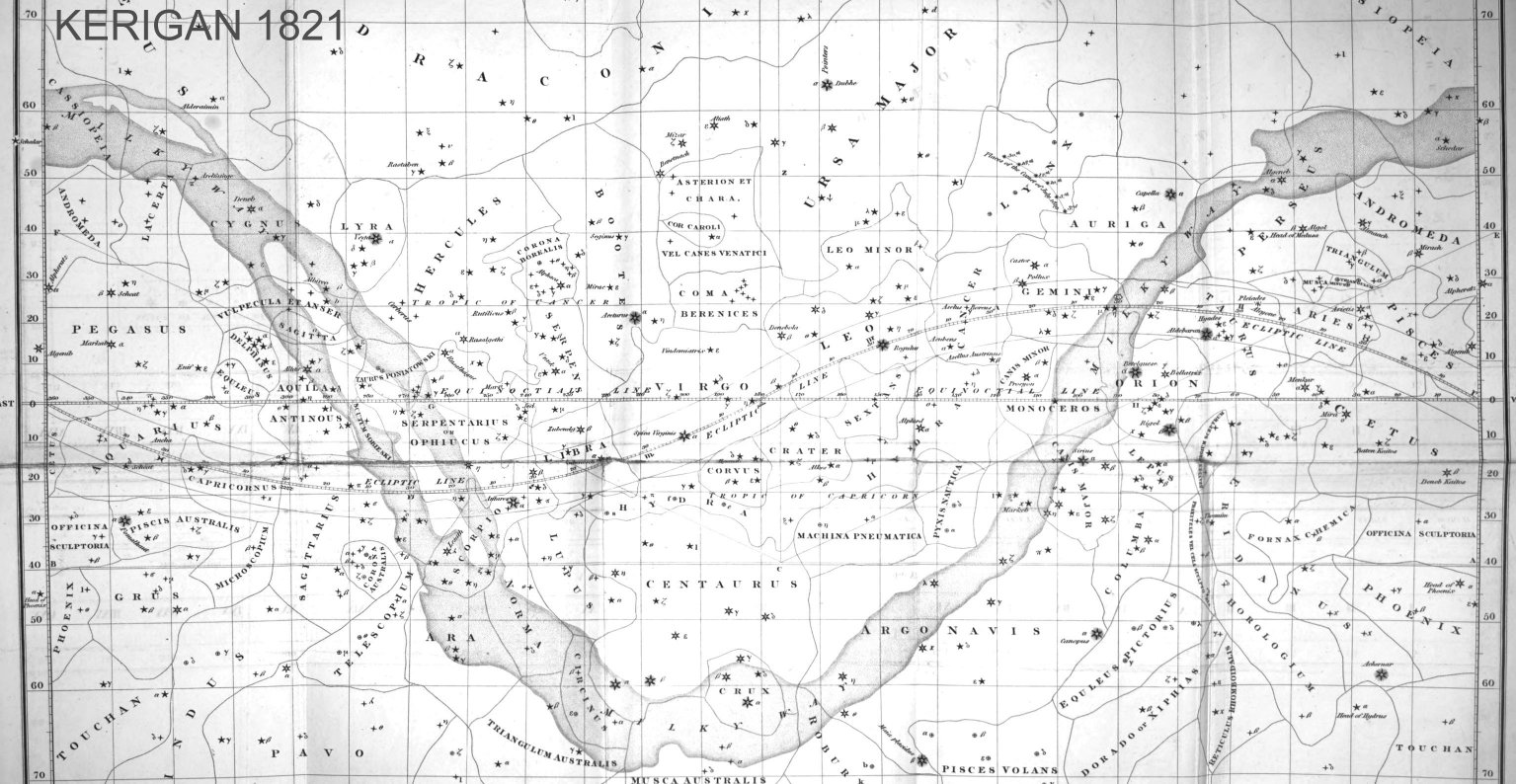
Why this strange "planisphere" chart? How does "Maia Placidus" appear out of thin air?? The simple answer appears to be that Burritt stole it (*). I discovered a couple of months ago (August, 2022) that Burritt's planisphere chart seems to be a direct copy (with some high latitudes wisely trimmed off) of a nearly identical Mercator projection of the sky in a nautical astronomy/celestial navigation work, "The Young Navigator's Guide...", published in Britain by Thomas Kerigan in 1821. Kerigan's chart includes constellation boundaries identical to Burritt's as well as the (otherwise inexplicable in Burritt's copy) path of a comet from 1819, and it also includes "Maia Placidus". Kerigan even works some computations using that star in the main text of his book.
We still have no explanation for the name "Miaplacidus". There's little doubt it's a modern coinage. Its origin is pushed back to 1821 at least, in Kerigan's navigation textbook. And now maybe the mystery of Burritt's peculiar "planisphere" chart may be solved. Burritt stole/borrowed the primary constellation artwork in his "Geography of the Heavens" from Jameson. He stole/borrowed his planisphere chart from Kerigan. This intellectual property "violation" was quite normal in the USA in this period. Nathaniel Bowditch mostly copied his "New American Practical Navigator" from British sources. Charles Dickens a decade later was infamously astounded to discover he was a pop superstar in the US despite never having made a dime off any of his books here.
* Alternative theory: both Kerigan and Burritt may have copied their "planisphere" Mercator charts from a third source, which I haven't yet seen. There's a Mercator planisphere by W. Croswell from 1810, which is broadly similar, but nothing like the near-perfect match between Kerigan and Burritt.
Frank Reed
Clockwork Mapping / ReedNavigation.com
Conanicut Island USA
Comments:
Thanks for a great app. The new option of using SI unit is really useful for us on the other side of the pond.
I have upgraded to the pro version and passed news of the upgrade to a friend learning to use her sextant. No doubt she will also relay this info.
Best regards
John Brown
Doug MacPherson
Lieutenant, USN sep.